| This uniquely formatted Internet version © 1997, 1998, 1999, 2001 by John Jason Hajicek, based on the 1987 version by James D. Hajicek. |
| This is the only accurate version available on the Internet. |
| In order to protect the integrity of our text, we do not allow this text to be copied for electronic use elsewhere. |
| Please do not infringe on our copyright. You may assign links to this page, or print a single-use hardcopy. |
This is the rare 1851 preliminary pamphlet edition, 80 pages long, of which only 200 copies printed. For years there was no copy known, until Yale University finally acquired one. This copy belonging to bishop Gilbert Watson has since been added to the Hajicek collection.
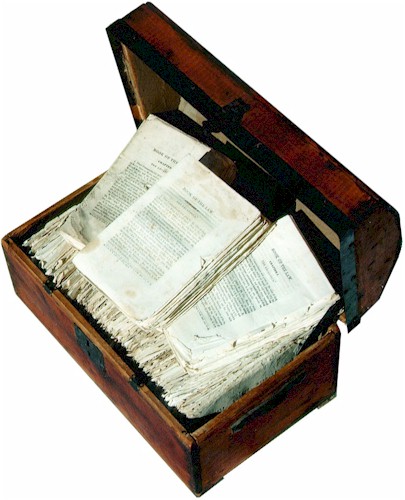
In 1856, the expanded 336 page edition of the Book of the Law of the Lord was laying in folded but uncut sheets in the printing office on Beaver Island. A mob pied the type and destroyed the press, but the apostles rescued the sheets and hid them in trunks like this one belonging to Warren Post in the Hajicek collection.
Portions of the manuscript Book of the Law of the Lord are in the rare collections of Brigham Young University, Southern Methodist University, and Yale University.
Be it known unto all nations, kindreds, tongues and people, to whom this Book of the Law of the Lord shall come, that James J. Strang has the plates of the ancient Book of the Law of the Lord given to Moses, from which he translated this law, and has shown them to us. We examined them with our eyes, and handled them with our hands. The engravings are beautiful antique workmanship, bearing a striking resemblance to the ancient oriental languages; and those from which the laws in this book were translated are eighteen in number, about seven inches and three-eights wide, by nine inches long, occasionally embellished with beautiful pictures.
And we testify unto you all that the everlasting kingdom of God is established, in which this law shall be kept, till it brings in rest and everlasting righteousness to all the faithful.
SAMUEL GRAHAM,
SAMUEL P. BACON,
WARREN POST,
PHINEAS WRIGHT,
ALBERT N. HOSMER,
EBENEZER PAGE,
JEHIEL SAVAGE.
|
||
| CHAPT. | SUBJECT. | PAGE. |
| Testimony | ||
| I. | The Decalogue | 17 |
| II. | The True God | 47 |
| III. | Oaths | 87 |
| IV. | Benedictions | 98 |
| V. | Maledictions | 100 |
| VI. | Prayer | 102 |
| VII. | Thanksgiving | 104 |
| VIII. | Sacrifice | 106 |
| IX. | Monuments | 110 |
| X. | Blessing of Infants | 114 |
| XI. | Baptism | 116 |
| XII. | Baptism for the Dead | 136 |
| XIII. | Confirmation | 142 |
| XIV. | Eucharist | 145 |
| XV. | Marriage | 159 |
| XVI. | Healing | 160 |
| XVII. | Absolution | 162 |
| XVIII. | Ordination | 163 |
| XIX. | Adoption | 167 |
| XX. | Calling of a King | 168 |
| XXI. | Duty of the King | 177 |
| XXII. | Abstinence of the King | 179 |
| XXIII. | Viceroys | 181 |
| XXIV. | King's Council | 183 |
| XXV. | King's Court | 185 |
| XXVI. | City Court | 187 |
| XXVII. | Municipalities | 188 |
| XXVIII. | Twelve Apostles | 191 |
| XXIX. | High Priests | 193 |
| XXX. | Seventies | 194 |
| XXXI. | Elders | 196 |
| XXXII. | Priests | 198 |
| XXXIII. | Teachers | 200 |
| XXXIV. | Deacons | 202 |
| XXXV. | Establishment of the Law | 203 |
| XXXVI. | Priesthood | 214 |
| XXXVII. | Place of Your Dwellings | 283 |
| XXXVIII. | Groves, Forests, and Waters | 286 |
| XXXIX. | Apparel and Ornaments | 288 |
| XL. | Feasts | 291 |
| XLI. | Inheritances | 298 |
| XLII. | Descent of Inheritances | 300 |
| XLIII. | Social Order | 305 |
| XLIV. | Household Relations | 310 |
| XLV. | Highways | 329 |
| XLVI. | Tithing | 331 |
| XLVII. | Payment of Debts | 335 |
| Chapter II. was written by the prophet James, by inspiration of God. | ||
| The first six sections of Chapter XX. were written by the prophet James, by inspiration of God, and the nine following sections are the words of the angel of God when he conferred upon James J. Strang the prophetic authority, and made him the chief shepherd of the flock of God on earth. | ||
| Chapter XXXV. is a revelation given Feb., 1851. | ||
| Chapter XL. is a revelation given Feb., 1851, except the first two sections. | ||
| The first three sections of Chapter XLI. are a revelation from God, given to James J. Strang, July 8th, 1850. | ||
| With these five exceptions all the other chapters of this book were translated from the plates of Laban, taken from the house of Laban, in Jerusalem, in the days of Zedekiah, king of Judah. | ||
CHAPTER 1
1. Thou shalt love the Lord thy God with all thy heart, and with all thy might, and with all thy strength: thou shalt adore him, and serve him, and obey him: thou shalt have no other gods before thee: thou shalt not make unto thee any image or likeness of anything that is in the heaven above, or in the earth beneath, or in the waters of the earth, to bow thyself unto it, or to worship it: thou shalt not bow down thyself unto, nor adore anything that thine eye beholdeth, or thy imagination conceiveth of; but the Lord thy God only; for the Lord thy God is a jealous God, visiting the iniquity of the fathers upon the children, from generation to generation, even upon all that hate him, and showing a multitude of mercies unto them that keep his commandments. (143, 597)
2. Thou shalt not take the name of the Lord thy God in vain: thou shalt not usurp dominion as a ruler; for the name of the Lord thy God is great and glorious above all other names: he is above all, and is the only true God; the only just and upright King over all: he alone hath the right to rule; and in his name, only he to whom he granteth it: whosoever is not chosen of him, the same is a usurper, and unholy: the Lord will not hold him guiltless, for he taketh his name in vain. (100, 367)
3. Remember the Sabbath day, to keep it holy. Six days shalt thou labour, and do all thy work, but the seventh day is the Sabbath of the Lord thy God: in it thou shalt not do any work; thou, nor thy son, nor thy daughter, nor thy manservant, nor thy womanservant, nor thy cattle, nor the stranger that is within thy gates: for in six ages the Lord thy God made the heavens and the earth, the sea and all that in them is, and rested the seventh age: wherefore the Lord thy God blessed the seventh day and hallowed it: thou shalt keep it holy unto him, that thou forget not the Law, nor be found keeping the company of the vile, nor be despised by the righteous. (129, 508)
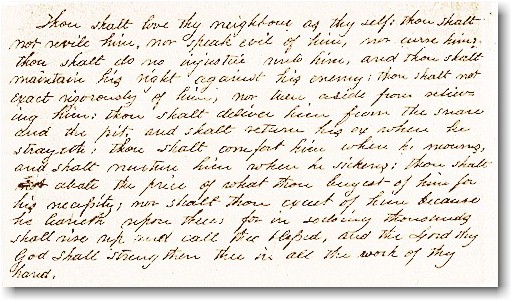
4. Thou shalt love thy neighbour as thyself: thou shalt not revile him, nor speak evil of him, nor curse him: thou shalt do no injustice unto him; and thou shalt maintain his right, against his enemy: thou shalt not exact rigorously of him, nor turn aside from relieving him: thou shalt deliver him from the snare and the pit, and shalt return his ox when he strayeth: thou shalt comfort him when he mourns, and nurture him when he sickens: thou shalt not abate the price of what thou buyest of him, for his necessity; nor shalt thou exact of him, because he leaneth upon thee: for in so doing thousands shall rise up and call thee blessed, and the Lord thy God shall strengthen thee in all the work of thy hand. (133, 558)
5. Honour thy father and thy mother: give heed to their commandments, obey their laws, and depart not from their precepts: reverence their age, and seek unto their house all the days of thy life: exalt not thyself against them, nor withhold to build up their house above thine own: honour and obey the King and the Judges, and the rulers, and all that are set in authority; for they are as fathers among the people: that they may be a fear unto evil doers; and the Priest also, who stands before the Lord, that he may instruct thee: and thy days shall be long upon the land which the Lord thy God giveth thee. (114, 476)
6. Thou shalt not kill: thou shalt slay no man in malice; neither thy child, nor thy wife, nor thy bondman, nor thy bondwoman, nor thy servant: nor the child of thy servant: neither shalt thou slay thine enemy, except thou admonish him, and entreat him, and he hear thee not, and God give him into thy hand: thou shalt only slay him in lawful war: and if any man trespass against thee, and break through, and do violence, thou shalt not slay him in revenge. If thou overtake him in the trespass, thou mayest resist unto blood; but except thou slay him in the trespass, thou shalt deliver him to the Judge; he shall judge him, and the hand of the officer shall be on him. (126, 518)
7. Thou shalt not commit adultery: thou shalt not in any wise lie with the wife of thy neighbour; and if she seduce thee, thou shalt resist her; that thou pollute not thyself, and make not the place of thy house unclean, and destroy not the house of thy neighbour, and that thou cause no violence in the land: thou shalt not lie with the wife of the stranger; neither shalt thou lie with the wife of thine enemy; lest thy children be scattered abroad, and know not thee, nor the fear of thee be upon them, and they be strangers to the covenant of God, and the whole land be corrupt, and thine offspring be destroyed with the wicked. (119, 495)
8. Thou shalt not steal: thou shalt not trespass upon anything that is thy neighbour's, to take it from him, nor to destroy it: neither shalt thou trespass upon the stranger that dwelleth within thy gates, to destroy his substance, nor to take it from him; for to thee he looketh for justice, and a shield round about all that he hath; and the fear of the Lord thy God is upon him also, and to his righteousness he also seeketh: neither shalt thou overreach him by cunning, nor by stratagem, to take his substance from thy neighbour, nor the stranger within thy gates. Remember that ye were strangers, and were oppressed, and oppress not the stranger, lest his cry ascend to God against you. (124, 545)
9. Thou shalt not bear false witness: thou shalt not speak falsely before the King, nor before the Judge, nor in the assembly of the Princes, nor in the presence of the Ruler, nor unto the Minister of the Law, nor among the multitude; nor in the ear of thy friend, nor to thy wife, nor thy child, nor thy servant: neither shalt thou withhold the truth from the King, nor the Judge, nor him that is set in authority: for thus shall righteousness be established in all thy borders. (89, 373)
10. Thou shalt not covet thy neighbour's inheritance: thou shalt not covet thy neighbour's house, nor his bondman, nor his bondwoman, nor his manservant, nor his womanservant, nor his horse, nor his carriage, nor the instruments of his labour, nor the produce of his land, nor the things that he has made, nor the treasures that he has in store, nor anything that is thy neighbour's: thy desire shall not be upon them, to take them by stealth, nor by fraud, nor by cunning, nor by violence: neither shalt thou covet that which belongeth to the stranger that dwelleth within thy gates; but thou shalt improve thine own, and thy desire shall be unto it; lest thou be corrupt, and the hand of thy neighbours be against thee, and the cry of the poor ascend to God against thee. (138, 605)
(10 sections, 1215 words, 5042 letters)
Return to Table
of Contents
CHAPTER 2
1. The God of Abraham, the God of Isaac, and the God of Jacob is our God; this is his name forever, and this is his memorial unto all generations. He created the heavens and the earth, and all things that are in them are the workmanship of his hands. He created man in his own image, that he might have dominion over the earth, and over the beasts of the field, and over the fowls of the air, and over the fishes of the sea. (85, 325)
2. Man, being in the likeness of God's person, they all recognize him as their Lord, and fear him as a God. And notwithstanding his degeneracy, he has retained so much of the divine likeness, that beasts, birds, and fishes, fear him, and his power is over them as a mighty one. It is diminished as he has departed from the likeness and perfections of his Creator: and that spirit of rebellion, which man has received so redundantly, he has communicated to them also, that they rebel against him, as he rebels against God. Yet the fear of man is on them continually; and his dominion is over them throughout the earth. (111, 484)
3. God conversed with Adam as a familiar friend; and walked with Enoch, who was faithful unto him in the midst of a corrupt race: he communed with Noah, the father of a new world; and covenanted by his own oath, with Abraham the faithful. (44, 185)
4. He commanded a fiery law, with a voice of thunder, in Sinai: the earth quaked at the tread of his foot: the rustling of his garment was as low thunder; and his voice as a mighty thunderbolt: the beaming of his face was as the sun in the morning; and the flash of his eye as the fierce lightning. The nations trembled at his presence; and the tribes said, Not unto us; not unto us, Oh Lord God, but unto Moses, be thy voice known. (85, 330)
5. For they heard the voice of God, as the voice of a trumpet; and as loud thunder: and they saw the lightning: and the mountain smoking; and they felt the earth tremble; and they fled far away, crying, Not unto us; not unto us: but unto Moses, declare thy law, Oh God, and we will obey his voice, and live, for, who shall abide in thy presence? (67, 259)
6. His word was made known to the Prophets, and his sacraments were established in Israel. Kings ruled in his glorious name; and the nations who forgot him were destroyed. (29, 136)
7. He hath appointed everlasting life in the Lord Jesus; and given the keys of death and of hell unto him who alone among mortals, hath kept his glorious word in all things. He hath chosen him the first born among many brethren; for he is the first begotten of the dead, and hath the keys of the resurrection, and of life forevermore. (62, 263)
8. He maketh his Apostles the witnesses of his Law, unto the nations; and of his gospel unto every kindred, and tongue, and people. His word is among men; and the revelation of his power, in the midst of the earth. (40, 164)
9. The Lord our God is glorious in his perfections; there is none like him. The gods of the heathen have no voice: neither do they see, nor understand. The God of Babylon the Great, the Mother of Churches, before whom all her daughters bow down, is naught; he is as wind, and vanity; he can neither be seen nor heard, nor felt; he hath no dwelling place: where shall any abide with him? Passionless, is he; and can neither love the good, nor hate the evil: who shall adore him, or fear him? (93, 374)
10. Without members and parts; he cannot hear, see, feel, smell, or taste. Neither can he speak, nor come unto those that worship him, nor smite the disobedient and rebellious. Handless, footless, mouthless, eyeless, and earless; a shapeless chaos, conceived in the imagination of the vain: ye shall not fear him, nor bow down unto him, nor adore him. (58, 271)
11. The Lord our God hath an incommunicable name; never polluted by the breath of the ungodly: which none can know, but he who ministereth in his holy sanctuary; by which he revealed himself unto Moses; and in which he establisheth this law, for an everlasting covenant. (46, 214)
12. God alone hath immortality. Adam, the first of men, the Ancient of Days, the great Prince; Abraham, to whom God gave an everlasting possession; David, whose throne was established as the days of heaven, forever; all died. Enoch, who walked with God, and was not found, because God took him; and Elijah, who ascended to the throne of God, in his own fiery chariot; shall return to the earth to sleep with their fathers. The change which is sealed upon all the sons of Adam, shall come upon the faithful, who stand on the earth, when the Lord Jesus shall be revealed from heaven, in flaming fire, taking vengeance on those who know not God, and obey not the gospel. And he, the Prince of the Kings of the earth; who in the days to come, shall speak with the voice of a trumpet, and the dead shall hear his voice and live; died once, that he might live forevermore. He praised God, who alone hath immortality, that he would not leave him in the place of the dead: he preached the gospel to the spirits in prison, and obtained the key of life everlasting: but God alone liveth forever: the eternal ages are unto him as moments to us: infinities, as units to the mathematician. Our God alone hath immortality. Thou shalt love him with all thy heart, and with all thy mind, and with all thy strength. (239, 1010)
13. God alone hath omniscience. He clotheth himself in light as a robe: his ministers, who at midday, are as a flaming fire in the dark night, are blind before him; he apprehendeth the motion of the atom which floateth in the invisible element, and discerneth the speck in the centre of the star, which the light of the sun hath not reached since the day that the sons of God shouted for joy that the earth was created, as a mountain in the eye of mortals. He never sleepeth; his eye closeth not; and there is no darkness before him. Our God alone hath omniscience. Thou shalt love him with all thy heart, and with all thy mind, and with all thy strength. (123, 512)
14. God alone hath omnipotence. He looketh upon the nations, and they melt in the fury of his countenance: he frowneth, and the mountains dissolve to smoke; the vallies are consumed in the breath of his nostrils. He spoke, and worlds were created: he thought, and they were lost in space. Earthquakes are but the whisperings of his voice; the rustling of his attire causeth lightning, and thunder; and with the shadow of his garment he blotteth out the sun. The Prince of the Kings of the earth; by whom the world was created; and who liveth and reigneth forever; receiveth power from him, and rendereth it unto him. Who shall stand before him? Our God alone hath omnipotence. Thou shalt love him with all thy heart, and with all thy mind, and with all thy strength. (136, 603)
15. God alone is omnipresent. His presence filleth the immensity of space as a point. In the midst of the bottomless pit, is he; the pavilion of his feet, is the face of the earth: the stars, are his home: his breath, is fragrant odour to the blessed, in the highest heaven; and it enliveneth the crumbling frame of the dead. The rays of the sun, have not found his bourn; nor the light of the stars, the place he inhabiteth not. His rest outspeedeth the lightning; it leaveth the morning ray behind it; and his speed is more rapid than the thought of angels. Our God alone is omnipresent. Thou shalt love him with all thy heart, and with all thy mind, and with all thy strength. (127, 526)
16. God alone is one. There are choirs of angels; hosts of spirits; and multitudes of men: but God hath no fellow. A great King, is to him as the unseen spawn before the monsters of the deep; Methuselah, as the ephemera of a day: the most glorious spirit, is bodiless, and a breath. And the Lord Jesus, who created the earth, and redeemed it; whose kingdom filleth the earth, and the heavens; possesseth but a speck, amid the stars he made. He alone is one. Thou shalt love him with all thy heart, and with all thy mind, and with all thy strength. Thou shalt adore him, and serve him, and obey him; and beside him, thou shalt have no other God: for he alone hath immortality, and omniscience, and omnipotence, and omnipresence. He alone is one; and they who obey his law, shall be like him. (147, 605)
(16 sections, 1492 words, 6261 letters)
Return to Table
of Contents
CHAPTER 3
1. Thou shalt swear by the name of the Lord thy God, and of the Lord Jesus Christ, and of the Holy Spirit of God, and by nothing less: neither by the heavens, for God's throne is there; nor by the hosts thereof, for they serve him; nor by the earth, for it is the place of the sole of his foot; nor by the inhabitants thereof, for they are mortal, and vanity; nor by thyself, for thou art of a day, and shalt cease; nor by any work of man, for it perisheth. (93, 343)
2. Remember that the Lord thy God swore by himself, because there was none greater: but by the greater shalt thou swear, even by God Almighty, and by him whom he sitteth at his right hand forever; and whose is the Kingdom under the whole heaven. Thou shalt not swear by the name of any other God. (56, 231)
3. Thou shalt not profane the name of the Lord thy God, nor of the Lord Jesus Christ, nor of the Holy Spirit of God, by any oath: but such oaths only as the Law of the Lord thy God, and the command of the King requireth of thee and alloweth, shalt thou take upon thee; for all else is profane. Thou shalt not profane the name of God by any oath or vow, of thine own. (76, 278)
4. An oath shall be before the King, and the Judge, and the Ruler, and the Minister of the Law; and before such as are set in authority, whensoever they require it: and there may be an oath also between those who enter into covenant: and also between him that serveth, and him that ordereth. (54, 226)
5. Thou shalt perform all thine oaths; whether unto God or unto man, thou shalt perform them. Thou shalt do according to every word that proceedeth out of thy mouth. Thou shalt not speak with thy lips when thy heart giveth not assent, to do and to perform all the words of thy mouth. (53, 222)
6. If thou swear by an oath to do anything which is known to thee, and it be sin, it is not an oath of the Lord thy God. Thou canst not profane the name of the holy, to sanctify sin. God shall judge thee, and him that asketh it of thee. Ye shall bear your sins together. (57, 203)
7. But if thou swear by an oath to do a thing, and it be hid from thee, and thou know it not, and when it is known to thee it is sin; thou shalt submit thyself unto the judgment of God, and shalt do penance; and shalt make restitution, as shall be put upon thee; that all sin may be put away, and thy heart purified, and wickedness put out of the land. (73, 266)
8. If thy wife swear by an oath to perform anything which thou mayest disallow, and thou hold thy peace at her, the day that thou hearest it, her oath shall stand. If thou wilt not that she perform it, thou shalt disallow it presently; for if thou delay, and then disallow it, thou shalt answer for her oath, and shalt bear her iniquity. (63, 262)
9. If thy son, or thy daughter, swear by an oath to perform anything which thou mayest disallow, and thou hold thy peace to thy child the day that thou hearest it, the oath shall stand. If thou wilt not that the oath stand, thou shalt disallow it presently; for if thou delay, and then disallow it, thou shalt answer for the oath, and shalt bear the iniquity of thy child. (70, 289)
10. And if thy servant swear by an oath to do a thing which thou mayest disallow, and thou hold thy peace at him, the day that thou hearest it, his oath shall stand. If thou wilt not that his oath stand, thou shalt disallow it presently; for if thou delay, and then disallow it, thou shalt answer for the oath, and shalt bear the iniquity of thy servant. (68, 273)
(10 sections, 663 words, 2593 letters)
Return to Table
of Contents
CHAPTER 4
1. Thou shalt delight in blessing, and not in cursing. And in the name of God, and of all the holy ones, even all that are above thee, shalt thou bless; and it shall be a blessing. (36, 135)
2. Thou shalt bless thy fellows, and thy children and servants, and theirs; and all who seek to learn the righteousness of God, and the peace of his Kingdom of thee, and all whom God has committed to thy care. And him who blesseth thee, shalt thou honour. (47, 198)
(2 sections, 83 words, 333 letters)
Return to Table
of Contents
CHAPTER 5
1. Thou shalt not curse, out of the bitterness of thine own heart; nor shalt thou curse any but he that is under condemnation of God's Law, and, being oft rebuked, will not repent. (33, 138)
2. Thou shalt not curse thy neighbour, nor the stranger that dwelleth with thee; for the hand of the Judge is over them: and, possibly, when he rebukes, they will repent, and turn to righteousness: but when he curses, then shalt thou. (41, 181)
3. But thou shalt not curse any who is placed in authority, or has jurisdiction over thee. If they oppress thee, or do thee unrighteousness, and thy cry ascend to God in heaven, in heaven will he hear thee. He will be the avenger. Curse not, lest thy curse return upon thee. (51, 212)
(3 sections, 125 words, 531 letters)
Return to Table
of Contents
CHAPTER 6
1. When thou prayest, thou shalt not use many words, or vain repetitions; for God hath understanding: nor shalt thou cry aloud; for God heareth the whisper of the heart. (29, 132)
2. Nevertheless, in the assembly shalt thou speak with an audible voice, that he who prayeth with thee, may say, Amen. (20, 91)
3. Thy prayers shall be unto God, thy Father; for he is rich in mercy, and loving kindness: and in heaven shall he hear thee, in the fulness of his wisdom and goodness, if thou believe on his name. But unto his Ministers shalt thou petition for whatsoever he has dispensed unto them. For his mercy is over all his works. (60, 249)
(3 sections, 109 words, 472 letters)
Return to Table
of Contents
CHAPTER 7
1. When, in blessing, the Lord thy God shall bestow upon thee any great and choice blessing; or, in his abundant charity, shall deliver thee from any great calamity, thou shalt assemble together thy wives, and thy children; thy friends, and thy neighbours; and shalt celebrate his glorious goodness with thankofferings, and feasting, and musick, and dancing. (56, 286)
2. And for the chief blessings of God to thee, shalt thou keep it in remembrance from year to year, and teach it to thy children, that they who inherit the blessing may not forget gratitude to the giver, and the remembrance of the goodness of thy God be preserved throughout all generations. (52, 232)
(2 sections, 108 words, 518 letters)
Return to Table
of Contents
CHAPTER 8
1. Thou shalt offer upon the altar of the Lord thy God, and before his Priests, sacrifices for sinofferings, and for trespassofferings, and for memorials, and for peaceofferings, and for thankofferings. (30, 163)
2. Thy offerings shall be of the firstlings of thy flocks, and of the choice of thy fields, and of the chief of all holy things. (25, 98)
3. Of thy flock shalt thou offer the firstling of male or female, without deformity or blemish, of such as divide the hoof and chew the cud; and of fowls, shalt thou offer all singing birds; and of fishes, all that have scales and fins; and of shell fish, such as have two shells, and move about from place to place: these shall be holy unto the Lord thy God, and shall be offered upon the altar. (76, 306)
4. Of the choice of thy fields, that which is good for food without change or addition, and whatsoever is used for bread for man, that is holy unto the Lord thy God, and shall be offered unto him as an offering, and lifted up to the Priest; but it shall not be offered on the altar. (56, 217)
5. And whatsoever other thing ye offer, it shall be accompanied with one of these, and thus thy gift shall be sanctified. But if it be not accompanied with one of these, thou shalt redeem it at the Priest's valuation, and it and the price thereof shall be the Lord's. (49, 208)
(5 sections, 236 words, 992 letters)
Return to Table
of Contents
CHAPTER 9
1. Whensoever the Lord thy God manifests himself unto thee in majesty and might, or walketh with thee, and revealeth unto thee wisdom and knowledge, thou shalt erect unto him pillars, tablets and enduring monuments, and make inscriptions upon them; and shalt write and inscribe thereon his dealings with thee, his blessings and mercies, and his great power and glory, which he hath revealed unto thee; that it may remain a witness to the generations to come; and that they may know that thy God is God, and there is none else. (91, 420)
2. Thou shalt preserve the memory of the chosen of God, who have been faithful in their ministry, and in the calling whereunto the Lord thy God hath called them, fresh with thy children, and thy children's children. (37, 170)
3. Thou shalt build monuments to their memory, and erect pillars and tablets, and inscribe their praises, their works, their faith and their sufferings thereon; and when thou beholdest their monuments, thou shalt remember them, and talk of their righteousness, and teach thy children to walk in their righteous ways. (49, 256)
4. When God giveth thee a victory over thy enemies, thou shalt commemorate it with monuments and inscriptions. (17, 89)
5. But over the graves of persecutors and blasphemers, and they who shed the blood of the innocent, and at the places of their abominations shalt thou pile rough stones, with muttered curses, against the day of the resurrection of damnation. (40, 194)
6. And thou shalt teach thy children to add a stone to the pile as they pass by, and to curse him that removes the stones, and cleaves unto their wickedness. (30, 122)
(6 sections, 264 words, 1251 letters)
Return to Table
of Contents
CHAPTER 10
1. When the Lord thy God in multiplying blesseth thee, and giveth thee a child in thine own image; thou shalt bring him before the Lord thy God, in his house, or in the assembly of the Elders; and they shall lay their hands upon him, and bless him. Thou shalt not delay to do it; and though thou be far away, yet shalt thou bring him before he is eight years old: that the blessing of the Lord thy God may be put upon him; and his heart shall seek to the Kingdom of God, and its righteousness: for of such is the Kingdom. If he die, yet shall he live therein forever. He shall be thine. (117, 450)
2. And the child of thy servant also, and of thy bondman, shalt thou bring to receive this blessing: and the stranger that dwelleth with thee shall bring his child also, to receive his blessing: for thus shall the power of the Kingdom be a shield unto him, and his heart shall cleave unto its righteousness; that he may be established therein forever. (62, 279)
3. And whosoever shall bring a child to be blessed; whether it be father, or mother; or master, or mistress; the same shall teach the child this law to keep it. Thus shall ye be honoured as fathers and mothers in Israel: but, if ye do it not, and evil befall the child, his blood be upon you. (57, 222)
4. The Apostles, High Priests, and Elders, in their assemblies; and the Priest thereunto appointed in the Temples of God, shall bless with this blessing: for, behold, it is a great sacrament. (31, 149)
(4 sections, 267 words, 1100 letters)
Return to Table
of Contents
CHAPTER 11
1. Except a man be born of the water, he cannot enter into the Kingdom of God. (16, 58)
2. But no man may have baptism of water, except such as have faith toward God, and come unto him through the ministry he has sent; repenting of evil deeds, and seeking to learn righteousness by the living word: for this is the door of all into the kingdom; from eight years old and upwards; through which if ye enter not, ye shall not see God. (65, 267)
3. For the keys of the ministry of the remission of sins, in the sacrament of baptism, hath the Lord your God bestowed upon his Apostles; and through them, upon their fellowlabourers, the High Priests, Elders, and Priests; commanding them to preach repentance and remission of sins, to all nations throughout the earth. (52, 255)
(3 sections, 133 words, 580 letters)
Return to Table
of Contents
CHAPTER 12
1. At every Temple, which thou shalt build unto the Lord thy God, by his Commandment, shalt thou make a fountain for the baptism of the living for the dead. (29, 121)
2. And for these shall you be baptized: every one of you, according to your several rights, and in your several orders, according to consanguinity, sex, and primogeniture, shall be baptized for any deceased husband, wife, or posterity; or any progenitor, to the third and fourth generation; or any brother, or sister, whom he in faith believes has received the gospel in the spirit. (63, 302)
3. Thou shalt also be baptized for any relative, within the fourth degree of consanguinity; for any one betrothed to thee in marriage; for thy fosterfather, mother, brother, sister, or child, whom I shall give to thee by tongue, dream, vision, spirit ministering in fire, word of angel, or by my own voice. (52, 238)
4. And whensoever I will that any of my faithful servants of the Aaronick Priesthood be baptized for any other, I will send my angels to signify it unto them. But unto my servants of the Melchisedek Priesthood, I will speak by my own voice, or minister in fire. (48, 206)
5. But no man or woman among you shall be baptized for the dead, who is not a member of some family, according to the order of the Church of the Firstborn of God; or who is under condemnation of any word of this Law; or who withholdeth anything whatsoever from the treasury of the House of the Lord your God. (60, 241)
6. At every Temple which ye shall build unto the Lord your God, shall High Priests be set apart, and sanctified by anointing with holy oil, and the hands of Apostles and Prophets, to baptize for the dead; for no other shall administer this sacrament. (44, 198)
7. Recorders, also, shall be set apart by the laying on of hands of High Priests, to record baptisms for the dead; who shall be eyewitnesses to the baptisms, and shall record according to the seeing of their eyes. (38, 167)
8. And other witnesses, who see with their eyes, shall sign the records of baptisms, that every one may be proved by the testimony of two or three witnesses. (28, 123)
9. But there shall be one record before the King, unto which all records of baptisms for the dead shall be brought, and all written together in perpetual archives; that what you record on earth, may also be recorded in heaven. At every Temple also shall ye perpetuate the record of such as are there baptized. (55, 246)
(9 sections, 417 words, 1842 letters)
Return to Table
of Contents
CHAPTER 13
1. Except a man be born of the spirit, he cannot enter into the Kingdom of God. (16, 59)
2. Whosoever shall be baptized for the remission of sins, upon him shall the Apostles, High Priests, or Elders, lay their hands, and confirm him in the Kingdom, and give unto him, by their hands, a gift of the Holy Spirit, according as the spirit will. (45, 195)
3. And the spirit thus given shall inspire him with faith, intelligence, and understanding; and if he cherish it, then shall it guide and establish him in all righteousness. (28, 138)
4. For when they lay their hands upon him, the spirit, like an invigorating breeze, shall come upon him and cover him; and it shall inspire him with a new power, according to the gifts of the spirit; and as it passeth off and leaveth him, his gift shall continue, and he shall walk in newness of life. (57, 233)
(4 sections, 146 words, 625 letters)
Return to Table
of Contents
CHAPTER 14
1. In your feasts of love, in your solemn assemblies, in your humiliation, and in your sorrow, ye shall separate of the juice of fruit, and of the bread of grain, a portion to be consecrated unto God, that it be the body and blood of the one great sacrifice of propitiation for the sins of the world: and they who are washed of their sins, and have a pure conscience before God, shall eat and drink thereof at the hands of the Apostles and High Priests, who shall consecrate it, and the Priests and Elders, who shall minister it, that, partaking of the sacrifice, they may lay hold on eternal life. (111, 468)
2. For this is the one great sacrifice, which except ye eat of it, there is no life in you. And beware how ye eat of this sacrifice: for in the spirit in which ye eat and drink, shall ye be confirmed and strengthened. And if ye eat and drink in a pure conscience, not having offended against God nor man, and all your former sins blotted out of the book of remembrance; ye shall be established in righteousness, and grow up into everlasting life. But, if ye eat and drink in your sins, ye eat and drink condemnation, confirming yourselves in your iniquities. (103, 438)
3. Therefore, when ye come to the table of the Lord your God, to eat of this sacrifice, ye shall examine yourselves, whether you have done injustice to man, or iniquity against God, that ye may humble yourselves before God, and make restitution to man; and may come with clean hands, and a pure heart, to this most holy sacrament. (59, 258)
(3 sections, 273 words, 1164 letters)
Return to Table
of Contents
CHAPTER 15
1. When thou takest a wife, thou shalt take such a one as thou lovest, and who loveth thee, and whom thou mayest lawfully marry: and thou shalt go before an Apostle, a High Priest, or the Chief of the Elders where thou dwellest, or the Priest who administereth in the Temple or the Synagogue; and by him shall ye be joined in marriage, that she may be thine in life, thine in the resurrection, and thine in life everlasting; and that the children which she beareth thee, may be with thee in the everlasting Kingdom. (95, 404)
2. And he who joineth you in marriage, shall unite her unto thee by an indissoluble bond; and shall give thee grace to love her, and cherish her, and protect her; and grace unto her to love thee, and nourish thee, and honour thee. (43, 177)
(2 sections, 138 words, 581 letters)
Return to Table
of Contents
CHAPTER 16
1. If Satan afflict thee that thou be sick, thou shalt send for the Elders, and they shall anoint thee with oil, and pray for thee, and rebuke the power of the adversary, and bless thee that thou recover of the disease. (41, 170)
2. But if thy sickness continue, and God deliver not thee therefrom, thou shalt confess thy sins to them, and they shall forgive thee; and thou shalt come to the assembly of those who have washed their robes, and made them white in the blood of the Lamb. (47, 199)
3. If an evil spirit enter into any of thine, and torment him, or lead him about, thou shalt send for the Elders or High Priests, and they shall put their hands upon him, and look upon him, and rebuke the evil spirit, and cast him out. (46, 179)
(3 sections, 134 words, 548 letters)
Return to Table
of Contents
CHAPTER 17
1. If thou sin a sin against God, or do an evil thing unto man, thou shalt go unto him who is God's Shepherd, wheresoever thou art, and between him and thee alone shalt confess unto him, and shalt keep nothing back; and he shall lay upon thee restitution, and penance, and shall judge thee in righteousness; and what he judgeth, that shalt thou do, according to all the words of the Law of the Lord thy God, and he shall forgive thee thy sin, according as God hath spoken. (89, 366)
2. And thou shalt in all things make restitution, as he judgeth thee; and if he require thee to confess unto the Judge who sitteth in judgment, or to any who is placed in authority, or to him thou hast injured, thou shalt do it; and otherwise thy sin remaineth upon thee. (51, 211)
(2 sections, 140 words, 577 letters)
Return to Table
of Contents
CHAPTER 18
1. Thou shalt not take upon thyself the honour of the Priesthood; neither shalt thou confer this honour on any but him whom the Lord thy God shall call. For no man shall administer in the name of God, but he that is called by the revelation of God's will, and set apart by the hands of those upon whom the authority of his name is sealed. (66, 264)
2. Whosoever is called by the voice of God to the royal authority, shall be anointed and ordained by the hands of those who stand in royal authority above him: but he that is first, by the angels of God; that he may have all the gifts; even wisdom, knowledge, faith, revelation, prophecy; and whatsoever gift is good for the Chief Shepherd of the flock of God: that he may be able to rule in righteousness: and they for their several callings, among God's flock. (84, 361)
3. And whosoever is called to administer at the altar, and in sacraments and ceremonies, shall be consecrated and set apart by the hands of those in like authority, according to the calling of God, for his ministry. (37, 171)
4. And whosoever consecrates another to the Priesthood of God, and the authority of his name, shall, with his hands upon his head, by his voice declare and seal upon him the name and authority of God; even that Priesthood unto which he consecrateth him. (44, 201)
(4 sections, 231 words, 997 letters)
Return to Table
of Contents
CHAPTER 19
1. If thou wilt in any wise adopt a child to be thine own, and to be heir to thee, thou shalt take him whom thou lovest, and whom thou mayest lawfully take; and thou shalt go before an Apostle, a High Priest, or the Chief of the Elders where thou dwellest, or the Priest who administers in the Temple or the Synagogue; and thou shalt take the child upon thy knee, and clasp him in thine arms, and shalt protest that thou lovest him as thine own flesh; and he shall seal him unto thee in the name of thy God: and shall sprinkle water upon him, and consecrate him thy flesh: and shall bless thee, and bless him in thy house; and he shall be thine forever. God shall give thee grace to be a father unto him, and grace unto him to honour thee. (146, 572)
2. And if thou hast a child who was not born in wedlock, and wilt assure him unto thee, thou shalt in like manner bring him, and protest he is thine, and he shall be sealed unto thee, that he be thine forever. (42, 159)
(2 sections, 188 words, 731 letters)
Return to Table
of Contents
CHAPTER 20
1. The Lord your God hath made the earth and established it, and unto him the dominion thereof belongeth. He created man, and gave him dominion over it. The nations are the workmanship of his hands; and he hath the right to rule. (42, 179)
2. He appointed Kings, and Rulers, and Judges; but man rebelled against them. He made laws, but man broke them, and trampled on them, and forgot them. (26, 114)
3. Unto Noah gave he dominion over the earth: and to Shem after him; but the people rebelled against him, and established their own ways; and those that oppressed them were their Kings, and ruled over them in unrighteousness. (38, 179)
4. Moses was King in Israel; but the people kept not the Law of God; and, rebelling, set up a false god, and worshipped it. When God would make them Kings to rule the earth, they despised his majesty, and went after other gods. (43, 173)
5. Men have everywhere rebelled against God: nevertheless, the earth is his, and the fulness thereof. The dominion of it belongeth to him, and he conferreth it upon whomsoever he will. (30, 146)
6. He hath chosen his servant James to be King: he hath made him his Apostle to all nations: he hath established him a Prophet, above the Kings of the earth; and appointed him King in Zion: by his own voice did he call him, and he sent his Angels unto him to ordain him. (54, 207)
7. And the Angel of the Lord stretched forth his hand unto him, and touched his head, and put oil upon him, and said, Grace is poured upon thy lips, and God blesseth thee with the greatness of the everlasting Priesthood. He putteth might, and glory, and majesty upon thee; and in meekness, and truth, and righteousness, will he prosper thee. (60, 266)
8. Thou shalt save his people from their enemies, when there is no arm to deliver; and shalt bring salvation, when destruction walketh in the house of thy God. Thou hast loved righteousness, and hated iniquity: therefore thy God hath anointed thee with oil, and set thee above all thy fellows. (50, 233)
9. Thy words shall be like sharp arrows in the heart of the wicked. Thou shalt rebuke those who pervert the word of thy God. Thou shalt preach righteousness and the sublime mysteries in the ears of many people; and shall bring the gospel to many who have not known it, and to the nations afar off. (56, 234)
10. Thou shalt drive backward and put to shame those that do evil; and the workers of iniquity shall fall. They shall be cast down, and shall not be able to rise. With purity will the Lord thy God arm thee, and purity and truth shalt thou teach. (47, 189)
11. Keep the Law of the Lord thy God in thy heart; and none of thy steps shall slide. With thee is the fountain of truth. In thy light shall the people of thy God see; for thou shalt speak his words unto them, and from thy lips shall they receive it. (51, 190)
12. The blessing of their God shalt thou put upon them, and his curse upon evil doers, if, after being oft rebuked, they repent not: and before my people shalt thou go, to lead them into my ways; for unto thee has the Lord thy God given salvation. (47, 189)
13. In righteousness shalt thou rule: thou shalt redeem the poor and the needy from suffering and violence; and to thee God giveth judgment for them. Thou shalt deliver the prey from the spoiler; for God, thy God, hath put them in thy hand. (43, 187)
14. And in weakness will he make thee strong. Thou shalt rule among his people. Thou shalt break in pieces the rod of the oppressor, and the yoke of the unjust ruler. They shall flee away, but the way of peace shall they not find. (44, 177)
15. While the day of the wicked abideth, shalt thou prepare a refuge for the oppressed, and for the poor and needy. Unto thee shall they come, and their brethren who are scattered shall come with them; and the destruction of the ungodly shall quickly follow; for it already worketh. Go thy way, and be strong. (55, 242)
(15 sections, 686 words, 2905 letters)
Return to Table
of Contents
CHAPTER 21
1. The King, when he sitteth upon the throne of his Kingdom and ruleth, shall write for him a copy of the Book of the Law, according to that which is before the Lord continually; and it shall be with him, and he shall read therein all the days of his life; that the fear of the Lord his God be continually before him, and that he remember the Law, and forget not to administer justice and judgment throughout the earth; and that he turn not aside from the Commandment one way or the other; to the end that he prolong his days in the Kingdom, and of his children among the faithful. (112, 455)
2. He shall execute judgment among the people, and over the Princes and Rulers, and over all that sit in judgment: he shall deliver the poor, the needy, and the oppressed: and if their cry be faint, yet shall he hear; he shall be a father to the fatherless, and a husband to the widow, and a guardian to him who hath no protector. (63, 254)
3. He shall overthrow the rebellious, destroy traitors, and punish those that do wickedly. The haughty shall he make low, and the oppressor shall he tread down: those that exalt themselves, shall he abase. (33, 163)
4. The power of the Lord God, he giveth to him, to rule the nations, and to execute judgments among the children of men: he shall declare the Laws and Commandments; exercise his dominion; and cast a shield round about the children of his people; that his dominion be not taken from him forever. (53, 231)
(4 sections, 261 words, 1103 letters)
Return to Table
of Contents
CHAPTER 22
1. He shall not multiply to himself horses: he shall not multiply to himself carriages: he shall not multiply to himself ships: he shall not multiply to himself armour: he shall have all these to defend his people, and the children of his people, but not to oppress them. (48, 214)
2. He shall not multiply to himself wives; lest he forget the Law, and avenge not his people: and lest his heart turn from them to strange women. (27, 112)
3. He shall not multiply to himself servants of the children of his people; lest his yoke be oppressive. (18, 82)
4. He shall not multiply to himself silver and gold; lest he be proud, and turn away from this Law, and do it not. (23, 85)
5. Neither shall he lead his people to strange places to dwell therein, which the Lord thy God hath not appointed for their dwelling; lest they depart from the Law, and despise it. (32, 142)
6. He shall not make other Laws, despising this; but all his Laws and Commandments shall be according to the Law of the Lord thy God, to establish it. For the Lord thy God shall speak. He shall decree, and he shall alter it as seemeth good unto him, and none shall hinder. (52, 210)
(6 sections, 200 words, 845 letters)
Return to Table
of Contents
CHAPTER 23
1. The King, when he committeth the administration of his Kingdom to another; or when he appointeth another to rule a portion in his name, may make him a Viceroy, and confer upon him Kingly dignity. (35, 156)
2. The Viceroy shall keep the King's Commandment, and shall not depart from it; he shall not exalt himself against the King: he shall keep none of his doings from the King; and he shall be faithful unto him, and to his house, in all things. (45, 185)
3. The Viceroy shall make no Laws: he shall govern according to the Law of the King, and the Law of God: if he deviseth a new Law, yet shall he not proclaim it, but by the King's Commandment. (38, 144)
4. He shall not do that which is forbidden to the King; but he shall exercise prerogative by the King's commission, in whatsoever part of his dominion he shall appoint him: he shall not despise the King's Commandment, nor do that which he disalloweth; lest he be a usurper, and be removed from his place. (54, 239)
(4 sections, 172 words, 724 letters)
Return to Table
of Contents
CHAPTER 24
1. The King shall be aided by a Council, to consist of wise men, chosen from among his people, learned in the Law of the Lord, and faithful unto the King; who shall assemble before him in council, as often as he shall require, to give him advice in whatsoever matter he shall ask them. (54, 221)
2. The King may apportion the administration of the Laws, and of the affairs of his Kingdom among them, giving to each his appropriate department, as the King shall command. (29, 138)
3. The members of the King's Council shall dwell near the King; they shall attend him on his journeyings, if he require it: they shall each give him information, reason, counsel and advice, of whatsoever matter he shall require, and shall keep nothing back. (43, 203)
4. Each member of the Council shall keep the charge of the King, which he committeth to him, in his several department; shall be a faithful Steward of the King's substance, in his hands: and shall render the same, with a just account of his stewardship, as often as the King requires. (51, 222)
5. The Counsellors of the King shall be chosen by him as seemeth him good, being just men, learned in the Law, not proud, nor haughty; not given to much babbling; and they shall keep the King's secret all the days of their lives. (43, 176)
6. If they serve the King well, he shall reward them as just and faithful Stewards. If they are unfaithful, he shall frown upon them. But he may choose new Counsellors, when it seemeth him good. (35, 151)
(6 sections, 255 words, 1111 letters)
Return to Table
of Contents
CHAPTER 25
1. The King shall appoint wise men, learned in the Law of God, lovers of righteousness, not fearing the rich, nor despising the poor, to be Judges; who shall sit before him continually, to judge all great causes. They shall sit upon the King's judgmentseat, at his gate: the ear of the Judges shall never be closed, that they cannot hear. This is the King's Court. (65, 282)
2. The King shall appoint twelve Judges to this Court, if so many are needed; all of them High Priests unto the Most High God; for the judging of all great matters; but all the smaller matters may be judged by other Judges, as the King shall appoint, that these may judge the larger causes continually, and that they judge upon the judgment of other Judges. (65, 282)
3. And the King shall order and determine what causes shall come before the King's Court, upon his judgmentseat to be judged, and what causes shall be judged before the other judgmentseats. (31, 152)
4. And the Judges shall hear and judge, and determine speedily: they shall not delay: and they shall judge righteous judgment, and shall not take reward, and do injustice. (28, 135)
5. And if they judge unrighteously, or refuse judgment to the just, or despise the Law, or take reward for judgment, the King shall remove them. When they have served faithfully, he shall relieve them in their age and infirmity. (39, 180)
6. The Deacons shall bring the disobedient, the stiffnecked, the peacebreakers, and all who have done great wickedness, before the Judges, and shall execute their judgment on all who withstand it, and obey not. (33, 168)
7. The Deacons shall execute all the orders of the Court, and shall be a fear unto the disorderly, and all revilers. They shall do whatsoever the Judges command. (28, 127)
8. The Chief Deacon shall be the Steward of the King's substance, which he committeth to the Judges, and shall render a just account of his stewardship to the King. (29, 129)
(8 sections, 318 words, 1455 letters)
Return to Table
of Contents
CHAPTER 26
1. The King shall appoint Judges in all the cities, three to a city, and more if the business of judgment require it: all of them Elders of the people; Priests of God; who shall sit upon the judgmentseat of the city, and judge all the causes which shall come before them; even all such as the King shall appoint unto them to judge. (63, 258)
2. They shall sit in judgment, on the judgmentseat in the Synagogue of their city, every Sabbath day, to do justice unto all men; and shall render speedy judgment upon all who have violated the Laws. (35, 157)
3. The Deacons shall execute their judgment upon all who obey not, and shall bring before them the peacebreakers, and all who do violence. (23, 110)
4. The Chief Deacon of the city shall be Steward of the King's substance, which he committeth to the Judges, and shall render a just account. He shall also be the principal Minister of the Court. (35, 153)
(4 sections, 156 words, 678 letters)
Return to Table
of Contents
CHAPTER 27
1. In every village an Elder shall be appointed to rule, to teach, and to instruct: he shall govern the village according to the Law, and the King's Commandment: to him shall the Priests of the Synagogue give heed; and if there be other Elders, they also shall give heed to him. (51, 216)
2. In every town shall Elders be appointed to rule, and teach, and instruct: five to a town: but if there be more than five Synagogues in the town, yet shall there be an Elder to each Synagogue, of whom one shall be Chief. (43, 170)
3. They shall govern the town according to the Law, and the King's Commandment: they shall instruct the people in the Synagogue, every one in his order: unto the Chief of them shall the Priests of that town give heed; and unto every one, in the Synagogue where he administers. (49, 217)
4. In every city shall Elders be appointed to rule, to teach, and to instruct, in all the Synagogues: but to the Synagogue of the judgmentseat of the city, shall three be appointed Judges of the Court of the city: another shall be appointed who shall be Bishop of that city; he shall be Chief of the Elders, both in that city, and in the towns and villages in its vicinity: to him shall they all give heed. (77, 316)
5. If there be more than one city in the province, then shall that bishop who is appointed to rule the province, administer in the chief city: he shall be an Archbishop: to him shall the other Bishops give heed. (39, 165)
6. But if there be no city in a province, yet shall an Elder be appointed to rule in that province: he shall be Bishop: and a Court shall be appointed also, and three Elders to be Judges: they shall be appointed at that place where the King will establish his government for that province. (54, 227)
7. By these shall the provinces, and cities, and towns, and villages of the Kingdom be governed: and officers shall be appointed to assist them in governing, as shall be necessary. The King shall establish his dominion in this order forever. (40, 192)
(7 sections, 353 words, 1503 letters)
Return to Table
of Contents
CHAPTER 28
1. When the Lord your God shall send the gospel to the nations, he shall call and choose twelve Apostles, to be the witnesses of his name and Kingdom, unto every nation, kindred, tongue, and people. (35, 154)
2. He shall appoint them Shepherds of the flock; under the direction of the Chief Shepherd: he shall make them Princes in his Kingdom: he shall appoint them to declare his Law unto all nations; and to execute it among the Saints who are scattered abroad. (45, 202)
3. The Apostles, every one, shall have jurisdiction of the Churches beyond the Kingdom, by appointment of the Chief Shepherd: they shall exercise royal authority in the Kingdom, by the King's Commandment. (31, 164)
4. Let them bear a faithful testimony to the nations: let them not shun to declare the whole counsel of God; and he shall give them rest from their labours; they shall be Princes forever. (34, 147)
5. One among them shall be Chief: to him shall they all give heed, as to a King among Princes: yet shall the Chief Shepherd be King over them all: they shall not rebel against his Commandment; and they shall be Princes in his Kingdom forever. (45, 189)
(5 sections, 190 words, 856 letters)
Return to Table
of Contents
CHAPTER 29
1. The Lord your God will choose faithful men, keepers of his Law, examples in righteousness, to be Priests of the order of an endless life. They shall be Princes and Nobles, and High Priests in the Kingdom of God. The presiding and ruling power is the prerogative of this Priesthood. (50, 225)
2. From the High Priests shall the King select Counsellors, and Judges, and Rulers. They shall sanctify things appointed of God to holy purposes, and shall minister in the salvation of the living and the dead. (35, 167)
3. One hundred and fortyfour High Priests form a quorum. From among themselves shall they choose one to preside in all their deliberations, and two to assist in presiding; but the King whom God shall set up, shall preside over all the High Priests. (43, 198)
(3 sections, 128 words, 590 letters)
Return to Table
of Contents
CHAPTER 30
1. The twelve Apostles shall select seventy Elders, chosen men, faithful in the ministry of the word, to preach the gospel, under their direction, unto all people. (26, 129)
2. One of the Seventy shall they appoint Chief: he shall be first in their assembly, and shall set them in order. (21, 87)
3. Other Seventies may the Apostles choose, until there shall be seven Seventies; and one shall be appointed Chief of each Seventy, to set his fellows in order, and to be first in their assembly. (34, 154)
4. The Seventies shall labour in the ministry of the word, and of sacraments and ordinances, onefourth of their time; and continually, if their households do not lack bread and raiment. (30, 148)
5. They shall have jurisdiction by appointment of the Apostles; and shall be Chief in the Churches they build up. (19, 90)
6. When they have laboured faithfully, they shall have rest, and a goodly inheritance among the just; but if they come short in the ministry whereunto they are called, their power shall be taken from them. (35, 163)
7. The Chief of the Apostles shall be the Prince and Grand Master of the Seventies: unto him shall they all give heed. (22, 92)
(7 sections, 187 words, 863 letters)
Return to Table
of Contents
CHAPTER 31
1. The wise men in every city, who love righteousness, and hate iniquity; who seek unto the Law of God and its justice; who obey the King, and honour all who are placed in authority, shall be ordained Elders. (38, 161)
2. These shall be Judges and Rulers, and shall govern and instruct in their several callings, as they shall be appointed: they are the leaders of the people. (27, 124)
3. The Elders shall read this Law all the days of their lives, that they may instruct the people therein, to keep it; and that they may be able to serve the King as Governours, and Rulers, and Judges, and Commissioners, and Masters of the King's business, in the several offices to which he shall appoint them. (56, 242)
4. When they go beyond the Kingdom to minister in word, and sacraments, and ordinances, the Apostles shall rule over them. (20, 96)
5. But they shall give heed to the Chief among them in their several cities, and one of the King's Counsellors shall be the Grand Master of them all. (28, 116)
6. The Elders shall instruct the people in the Law and the gospel on the Sabbath day, and in their assemblies: they shall visit the sick, the poor, and the needy: they shall comfort mourners, and all who are distressed, and counsel those who know not right. (46, 201)
(6 sections, 215 words, 940 letters)
Return to Table
of Contents
CHAPTER 32
1. Faithful servants of God; godly in their walk and conversation; not given to strong drink, nor lust, nor lasciviousness; shall be ordained Priests, in all the cities, and in every town and village which hath a Synagogue. (37, 176)
2. They shall be Keepers and Ministers of the Temples and Synagogues, and shall be Ministers and Singers, and shall serve in all callings in the worship of God; and in all the ceremonies which shall be appointed for worship and adoration. (41, 191)
3. The Priests shall also assist the Elders in the work of preaching, and shall visit from house to house to teach godliness among the people, and shall baptize for the remission of sins. (33, 149)
4. Whenever the Lord your God shall command you to build a Temple unto him, that he may come and dwell in the midst of you, then will he establish a peculiar Priesthood, to administer the ordinances of that Temple. (39, 169)
5. One of the Priests in every Temple shall be Chief, and to him all shall give heed. But in every Synagogue the Priests shall give heed to the Chief of the Elders. (32, 127)
6. One of the King's Counsellors shall be Grand Master of all the Priests. (13, 57)
7. Godly women shall be Singers and Musicians, and assistants in the ceremonies, but they shall not kill sacrifices. (18, 93)
(7 sections, 213 words, 962 letters)
Return to Table
of Contents
CHAPTER 33
1. In every city, town, and village, ye shall ordain Teachers, men and women who are apt to teach, learned in letters, and in every science, and every manner of wisdom and knowledge; that they may instruct you and your children, and that you may attain to all wisdom and all knowledge. (51, 222)
2. In every Synagogue shall Teachers be appointed to instruct the people on the Sabbath day in the ways of the Lord, and in the words of this Law. The children of the rich and the poor, shall come together to learn of them, without price. (45, 186)
3. One of the King's Counsellors shall be the Grand Master of all the Teachers: he shall be Chief in their assemblies, and shall set them in order; to him shall they all give heed. (34, 139)
4. The Teachers of eminence shall be set apart as Doctors: but if any have attained to very great eminence, they shall be Rabbis, and the most eminent of all shall be Rabbonis. (32, 138)
5. Ye shall establish schools in all your cities, towns and villages; to every one shall a Teacher be appointed; but to the large schools many, that they may be able to faithfully instruct all who come unto them. (38, 167)
6. In every city shall ye establish an Academy: a learned Doctor shall be the Chief Teacher therein. (17, 79)
7. In every city shall a College be established: a learned Rabbi shall be Chief Teacher, and he shall have Doctors for his assistants. (23, 106)
8. If the city be very large, then may you establish other Colleges; and in all the cities, and large towns may you establish other Academies; and the Chief Teacher where there are several Academies, shall be a Rabbi; and where there are several Colleges, shall be a Rabboni. (48, 217)
(8 sections, 288 words, 1254 letters)
Return to Table
of Contents
CHAPTER 34
1. In every city shall ye ordain Deacons; lovers of the Law; men of stout heart, strong arm, and swift foot: men who neither despise the poor, nor fear the rich; kind, persevering, and just; seeking unto the Kingdom of God and its righteousness. (43, 189)
2. The Deacons shall be Ministers unto the King, the Judges, and the Elders, to execute their Commandments, both in judgment and mercy: they shall be merciful and just. (28, 132)
3. The Deacons shall be Stewards and keepers of the King's prisons: and Stewards of the King's Courts. (17, 79)
4. In the cities, and towns, and prisons, shall Chiefs be appointed over them: but one of the King's Counsellors shall be their Grand Master. (24, 109)
(4 sections, 112 words, 509 letters)
Return to Table
of Contents
CHAPTER 35
1. Fear not, little flock, for your Father, in his good pleasure, hath given you the Kingdom; the dominion is yours forever; ye shall smite the nations with a continual stroke; for the Lord your God hath spoken it: ye shall break them in pieces, and destroy them; for the day of his vengeance has come. (55, 234)
2. He hath judged the nations that are near, and decreed destruction upon them, and their day continueth not: the nations far away are covered with their abominations as with a garment: their iniquities are not hid: he will not spare them. (41, 190)
3. The Saints of the former days have sat in judgment upon them; they have judged the earth, and the nations thereof shall not be spared: fire goeth before: famine followeth after; and the pestilence shall waste them. (37, 172)
4. Arise and smite them, O Daughter of Zion; and thou, O Tower of the Flock, whose power is above the clouds, possess thy dominion, and be thou a refuge: for Judah shall be bent, in his strength; as an arrow, Ephraim shall fill him: Manasseh shall be his barb; and Jacob shall be in the midst of the Gentiles, in the empire of nations, as a Lion among the beasts of the forest; as a young Lion in the flocks of sheep, who, when he goeth through, treadeth down and teareth in pieces, and none shall deliver. (97, 387)
5. Let your fear be upon all men; and the terrour of you upon your enemies; for this is the day of vengeance of the Lord, and of your recompense upon your enemies. Joseph shall possess his land again; for the throne of David is established as the days of the sun; his Kingdom is everlasting. (55, 227)
6. And now, O Daughter of Zion, the land of robbers, the empire of many nations, shall gather her troops against thee, to look upon thee, and to defile thy dominion: but they have not known the thought of the Lord; neither have they understood his counsel; for he shall gather them as sheaves of the floor. (56, 238)
7. Arise and thrash, for I will make thy power iron: the tread of thy foot shall crush: thou shalt break in pieces many people, and shalt consecrate their spoil unto God, and their dominion to the Lord of the whole earth. (41, 172)
8. Babylon the Great shall perish before thee; for thou shalt do unto her as she hath done unto thee: thou shalt render unto her as she hath rendered to thee, and reward her double for all her sins. Her cities shall be given to the flames, and the inhabitants to the sword: her government shall be broken in pieces, and her dominion taken away. (64, 270)
9. For in her is found the blood of Saints and Prophets; and the spoil of the children of God in the midst of her: and she hath drank of the cup of the indignation, and of the fury of God, with all the nations of the Gentiles. (47, 172)
10. Against her, Apostles have washed their feet on earth, and borne witness in heaven; and by the testimony and the blood of Prophets have her sins been made known in heaven: the great Prince, whose throne is as burning fire, hath judged her, saying, Let not her days be prolonged. (50, 220)
11. For by this Law shall men be judged in the portion of Joseph: God will give it to you, that you may possess it for an everlasting dominion. In the midst of the Gentiles shall ye establish your Synagogues, and gather out the just while ye wait for the judgments of God. (52, 212)
12. Ye shall, therefore, read in it all the days of your lives. Ye shall read it in your solemn assemblies, and in your joyous meetings; with the shout of triumph when your enemies flee before you; and in the voice of mourning when you have sinned against God, and have fled before them; ye shall read it in the gathering of your neighbours, and in the household with your children. (70, 299)
13. Ye shall talk of it in the house, and in the field, and by the wayside, and in the forest, and on the waters; in the camp, and on the march: when ye labour, and when ye rest shall ye speak of this Law to your neighbours, and to your wives, and to your children, and to your servants. (59, 213)
14. And ye shall think upon it in your joy, and in your sorrow; when upon the land which the Lord your God giveth you, and when far away; both in the midst of the multitude, and in your loneliness; all the days of your lives shall ye read it, and talk of it, and think upon it; and it shall be inscribed upon your hearts continually. (66, 254)
15. For by this Law hath the Lord your God sanctified you, and given you judgment, and justice, and dominion. Remember that ye stood before him; your King, and your Princes, and your Nobles, the men of you, with your wives and your children, and your little ones, and entered into covenant with the Lord your God, to be a people unto him, and to obey his Commandments, and to keep this Law; and that he covenanted with you to be your God, and to make you a nation of Kings and Priests to the nations of the earth. (98, 395)
16. Keep, therefore, this Law, and obey these Commandments; for so doth God sanctify you, and so will he establish you, and prosper you, more abundantly than in former days. The land of Joseph shall ye possess forever, and Israel and Judah shall dwell again upon their own mountains. (48, 222)
17. Your vineyards, your gardens, and your orchards, ye shall plant again, and they shall flourish, and ye shall eat the fruit thereof: ye shall build houses, and shall inhabit them; and children's children shall be in them, for a crown of glory to you, if ye remember the Lord your God, whose name is great and glorious, and keep his statutes. (61, 266)
18. And now if there be among you a man whose heart turneth away from the Lord your God, to serve the god of Babylon, and to honour the names of the nations; if there be a root that beareth gall and wormwood; and when he heareth the curse in this Law, he bless himself, saying, I shall have peace, though I walk in the imagination of my heart, the Lord will not spare him. (74, 285)
19. But the anger of the Lord, and his jealousy, and his fierce wrath, shall smoke against that man: and all the curses that are written in this book shall be upon him, and the Lord shall blot out his name from under heaven. (43, 172)
20. At the end of every seven years, in the solemnity of the year, when all the children of the Kingdom are gathered together before the Lord in Temples, and in Tabernacles, and all the people are assembled, Princes and Nobles, men, and women, and children, and the stranger that dwelleth in your gates, ye shall read this Law before them all, in their hearing, and shall make it known in the midst of them. (74, 317)
21. And your children, and the strangers dwelling in your gates, that have not heard it, shall learn this Law, and ye shall all remember it again, and shall all lift up your hands, and shall enter into covenant with the Lord your God to keep this Law, and to obey his statutes, that he may prolong your days upon the land. (61, 249)
(21 sections, 1249 words, 5166 letters)
Return to Table
of Contents
CHAPTER 36
1. There are two Priesthoods: the Priesthood of an endless life; and the Priesthood of life. (15, 72)
2. In the Priesthood of an endless life are two Orders; that of Apostles, and of Priests. (16, 68)
3. Of Apostles there are four Degrees. (6, 29)
4. The first Degree is that of Lawgiver, and is Apostle, Prophet, Seer, Revelator and Translator. This Degree is sole, and gives the word of God as from his own mouth. (30, 128)
5. The second Degree is that of Counsellor, and is Apostle, Prophet, Seer and King. (14, 63)
6. The third Degree is that of Embassador. Of these there shall be twelve. They shall be Apostles and witnesses to the nations, and Rulers in all places where the Lawgiver shall send them. (33, 149)
7. The fourth Degree is that of Evangelist. Evangelists are Apostles, and witnesses of the Kingdom, to whatever nation they are sent. Seven are a full Quorum; and there shall be but one Quorum to any nation, kindred, tongue or people. (40, 184)
8. Of Priests there are two Degrees. (6, 27)
9. The first Degree is that of High Priests. (8, 33)
10. The second Degree is that of Elders. (7, 29)
11. In the Priesthood of life are three Orders; that of Priest, of Teacher, and of Deacon. (16, 67)
12. Of Priests, of the Priesthood of life, there shall be a Chief Priest, a first and second High Priest, and a Leader of each Course of Priests, to every Temple. (30, 123)
13. This Priesthood shall be divided into Courses, according to the nature of their duties; and officers appointed in the several Courses, to guide and direct in the duties of the Course. In organizing the Courses, those may be included who have been ordained to a higher Priesthood. (47, 227)
14. Of Teachers there are five Degrees; Rabboni, Rabbi, Doctor, Ruler, and Teacher. (12, 62)
15. Of Deacons there are three Degrees; Marshals, Stewards, and Ministers. (10, 57)
(15 sections, 290 words, 1318 letters)
Return to Table
of Contents
CHAPTER 37
1. Ye shall not scatter abroad, after the manner of other men, nor dwell alone in the fields; ye shall dwell together in cities, in towns, and in villages. Your inheritances shall be appointed to you, both in the places of your dwelling, and in the fields and forests round about. (50, 219)
2. In the fields and forests may you go and dwell, when you labour there, but ye shall return; and your treasures, your granaries, and your storehouses, shall be at the place of your dwellings. (34, 150)
3. And if ye would in any wise go and dwell among strangers to gain power over them, or to get riches, or for any other reason whatsoever, ye shall not go except by permission of your King and of the Rulers whom he shall command, lest ye be led away of your own lusts, and be estranged from the Lord your God, and be cast off forever. Moreover, if ye go without permission, ye shall be spoiled of your goods; and except ye repent and return, ye shall not have a place in the congregation before the Lord. (98, 392)
(3 sections, 182 words, 761 letters)
Return to Table
of Contents
CHAPTER 38
1. Ye shall not cut down the timber on the hills and mountains, lest your children suffer for want of wood and water. Ye shall not destroy the groves along the shores of the lakes and ponds, lest the winds and storms make your land desolate, and both heat and cold destroy you. Therefore shall ye cause them to grow continually, and they shall beautify your inheritance, and your children shall rise up and call you blessed. (76, 338)
2. Every man who receiveth an inheritance shall preserve a forest thereon, that his children may walk in the shade thereof, and may build houses and prepare food; and that his cattle faint not with heat or drouth, nor perish in the blast; and the land yield her increase. If there be no forest, he shall plant one. (57, 247)
3. Ye shall preserve the trees by the wayside. And if there be none, ye shall plant them. Whether it be in the cities, towns, and villages, or the fields and forests, ye shall do it. (35, 137)
4. All these things shall ye do as your King shall appoint, and your Rulers determine, that the land be pleasant to your children. (23, 102)
5. And in your cities, and towns, and villages, and by the side of great waters, and ponds, and running streams, and springs, shall groves be appointed to you, that the aged and the young may go there to rest and to play. There shall ye all make yourselves joyful. (49, 203)
(5 sections, 240 words, 1027 letters)
Return to Table
of Contents
CHAPTER 39
1. Ye shall not clothe yourselves after the manner of the follies of other men; but after the manner that is seemly and convenient, shall ye clothe yourselves. (27, 127)
2. And your King, and your Princes, and your Judges and Rulers shall clothe themselves according to their dignity: and the Priest who administers at the altar, and he who administers in the sacraments which I appoint unto you, shall clothe in the robes of his office. (46, 213)
3. And all the people in their solemn assemblies, and in their gatherings together, shall clothe themselves according to my Commandment. (20, 111)
4. And the ornaments of your persons, and of your apparel, shall every man wear, as I shall appoint; every man in his own order. (24, 97)
(4 sections, 117 words, 548 letters)
Return to Table
of Contents
CHAPTER 40
1. These are the feasts of the Lord; holy convocations, even convocations and feasts unto the Lord your God. (18, 85)
2. Six days shall work be done, but the seventh day is the Sabbath day: ye shall do no work therein: it is the Sabbath of the Lord in all your dwellings: ye shall take care that nothing perish, but ye shall not labour for hire nor increase; ye shall have a holy convocation in all your Temples and Synagogues. (59, 241)
3. The day that James, the Prophet of God, was established King, and sat upon his throne, is a notable day; it shall be kept in remembrance forever. (27, 113)
4. As oft as this day returneth shall all the Saints assemble together. It shall be a holy convocation. They shall assemble in their Temples, and in their Synagogues, and in publick places, to offer a thankoffering, an offering of praise unto God, because he has given the Kingdom to the Saints. (51, 234)
5. The King shall, therefore, offer a heifer, without blemish; in the presence of the congregation shall he offer it. In the morning shall he offer it, and the same day shall it be eaten: he and his household shall eat of it. Not a bone of it shall be broken: they shall eat it with bread, and seasoned with herbs. (60, 241)
6. After this manner shall all the children of the Kingdom sacrifice: every man a heifer, or a lamb, or a dove. Every man a clean beast, or a clean fowl, according to his household. (34, 138)
7. Ye shall take the victim of the sacrifice which ye shall offer, and shall bring it before the Lord in the presence of the congregation, and shall bring it to the Priest, and shall say, (35, 146)
8. I profess this day unto the Lord God, that I am come into the Kingdom which he promised by the mouth of all the Prophets: praised be his name for his glorious goodness, and his great power. (37, 149)
9. And the Priest shall slay the victim, and thou shalt say, We were a people, few in number; scattered among our enemies: they killed our Prophets, murdered our brethren, robbed us of our possessions, and banished us from among them; but God has made us a Kingdom: and the fear of us is upon those who hate us. (58, 240)
10. When the Gentiles evilly entreated us, and afflicted us, and thrust us out, we cried unto the Lord God of our fathers; the Lord heard our voice, and looked on our affliction, and sorrow, and homelessness; and he gave us this land for an everlasting possession; and hath made us a Kingdom: and now have I brought unto him this victim for a thankoffering, and a perpetual memorial. (68, 300)
11. And thou shalt eat of the sacrifice: thou and thy household, and thy neighbour; but the stranger, though he dwelleth in thy gates, and in thy house, shall not eat of it: thou shalt eat it with herbs, and the Priest with thee, in the congregation of the Lord; it is a holy convocation, and a feast unto the Lord: ye shall do no servile labour that day. (68, 271)
12. And when thou hast eaten, thou shalt say unto the Lord thy God, I have come into the land which thou gavest to thy Saints: I have heard thy Law, and have entered into covenant with thee to keep thy Commandments; and I have eaten of the sacrifice before thee as a witness forever. (54, 220)
13. Look down from thy holy habitation, from heaven, and bless us this day, even all the children of thy Kingdom; and the land which thou hast given us, and establish us forever. (32, 137)
14. When ye are come into the land which the Lord your God giveth unto you, and have gathered the harvest of your inheritance, ye shall bring a portion of the firstfruits of your fields before the Lord your God, for an offering of firstfruits. (44, 192)
15. At every Temple where the name of the Lord your God is named, shall the Priest appoint the day of firstfruits, according to the days of your principal harvests of food; and by that day shall ye all bring your offering of firstfruits unto the Priest, in the Temples and the Synagogues, and ye shall have a holy convocation before the Lord in every place to which ye bring the firstfruits. (71, 311)
16. Ye shall lift up unto the Priest who ministereth unto the Lord a portion of firstfruits, by the day of the holy convocation of the harvest; on the selfsame day ye shall offer an offering of flesh also; a clean beast, or a clean fowl: it shall be a sacrifice and feast of thanksgiving unto the Lord, for the abundance of the harvest. (63, 263)
17. And ye shall not eat of your harvest, neither bread, nor grain, nor green ears, nor roots, nor germs, till ye have brought your offering of firstfruits before the Lord your God. He that eateth thereof, shall add a fifth to what he ate, and bring it and the increase, and the firstfruits also: and the firstfruits shall be an abundance for the feast, every one for his household: and the rich shall bring for the poor, out of his abundance, and for the Priests also that minister. (88, 376)
(17 sections, 867 words, 3657 letters)
Return to Table
of Contents
CHAPTER 41
1. I have appointed the Islands of the Great Lakes for the gathering of the Saints, saith the Lord God. I have given the Islands to them for their inheritance; even all that man walketh not unto from the main. (39, 164)
2. And I have appointed my servant James the anointed Shepherd of my flock, to apportion unto every one his portion, for a perpetual inheritance. (24, 116)
3. Let him, therefore, appoint unto every one his inheritance, sufficient for him, and for his children: and to the Princes their portions, that they have an abundance for their servants, and their households; lest they be tempted to take reward for judgment, or feed not the poor for lack of bread, or deliver not the oppressed for the weakness of their arm. (62, 284)
4. Ye shall not sell your inheritances: nor shall ye deliver them to the hands of strangers, to possess them. Ye shall in no wise grant them to others: for they are the dwelling of your wives, the food and raiment of your servants, and the home of your children. (49, 204)
5. If ye sell your inheritances, and take a price for them, yet shall not the purchaser possess them. They shall not be his forever. And though you thrust him not out, yet shall your wives, your servants, and your children return to them, and none shall hinder. (47, 203)
6. And a book of inheritances shall your King keep, and your Rulers also shall keep them, that every man may read therein, and trespass not upon his neighbour. (28, 125)
7. Ye shall set up landmarks to your possessions, and no man shall move them. If ye set not up landmarks, or neglect to keep them up that they go to decay, and are lost, and one trespass unwittingly, ye shall not punish him. He shall pay for what he hath gotten, or he who hath suffered the trespass shall pay him for his labour, and take his own, if he will. (71, 275)
8. If strangers or enemies set up landmarks against you, ye shall destroy them. They shall not remain. (17, 80)
(8 sections, 337 words, 1451 letters)
Return to Table
of Contents
CHAPTER 42
1. If a man die leaving sons, his inheritance shall belong to them, and it may be parted among them. And to the firstborn, or he that is worthy to be so reckoned, shall be given a double portion, that he may keep up the dignity of his father's house. (49, 191)
2. The sons which he hath adopted shall be reckoned with the sons he hath begotten. They are his. But if any of his sons have received an inheritance already, they shall not receive a portion with their father's children. (39, 175)
3. No man shall receive two inheritances, lest his neighbour have none. But if he receive another, or if he marry an heiress, he shall surely give up the former, that it may be given to him who hath none, or who lacketh a portion. (44, 177)
4. If a man die having no sons, but daughters, the inheritance shall belong to them: the men who shall take them to wife, shall be called after the name of their fathers, every man after the name of his wife's father: otherwise he shall not possess the inheritance. Thus shall the house and the name of him be kept up, who hath no son. (64, 259)
5. But if he have neither sons nor daughters, and he be found a righteous man, then may the King appoint his nearest kinsman who is found worthy, and is not the firstborn of his father, his heir; and he who is thus appointed shall be called after the name of him who had no child. Thus shall his name and his house be kept up. Otherwise shall the King give his inheritance to him who is needy. (77, 306)
6. If a man desert his inheritance for a long time, that it be left to decay and waste, or become wild, that the portion of the house of the Lord, and the treasury of the King fail, then shall the King's servants possess it. And the King may take it to himself, or grant it to another who needeth it. (60, 229)
7. If the sons of him who has left his inheritance return, the King's servants shall render it to them. But if the King has taken it to himself, or granted it to another, then shall the King give them another inheritance. (41, 172)
8. If any man will leave his inheritance to seek a place in another land which the Lord your God giveth you, then shall he render his inheritance to the King, who shall appoint him another, that his children may possess it instead of the former, and his house and his name be not lost among the Saints. (57, 238)
9. If the King seek men to go up to a new land to possess it by the Command of the Lord your God, then shall the sons among many brethren go up and establish their houses, and their names shall be named upon their inheritances, that they may be kept up forever. And they shall not inherit with their brethren of the possessions of their father. (66, 271)
10. Thus shall every man have an inheritance, or a portion, and they shall not be divided till they are too small for you. (23, 93)
11. If an inheritance have been divided, and one who hath a portion die leaving no child, or render it up to receive another, it shall not be given to a stranger to his house. It shall return to the head of the family to whom the inheritance pertaineth. (48, 197)
12. And if he die leaving no sons, but a daughter, and any of her kinsman who has also a portion of that inheritance take her to wife, he shall have her portion with her. (34, 129)
(12 sections, 602 words, 2437 letters)
Return to Table
of Contents
CHAPTER 43
1. Thou shalt not abide in the conversations of the ungodly; the corrupt desires of deceitful lusts; as an old man unchanged; but shalt be renewed in the spirit of thy mind; that thou be a new man; growing into the likeness of God's perfections; born anew in righteousness and true holiness. (51, 230)
2. Put away lying: speak every man the truth to his neighbour; let no corrupt communication proceed out of thy mouth; but that which is good to edifying, and increasing faith; that it may minister grace to the hearers: grieve not the Holy Spirit of God, by which thou art sealed unto the day of redemption. (55, 241)
3. Put away anger, wrath, bitterness, and malice; and be ye kind one to another, tender hearted, forgiving one another, even as God forgiveth you; followers of God as dear children, walking together in love. (34, 161)
4. The first power over every child is the mother: the highest power in any household is the father of the family, the head of the house: to him let all give heed; but the Law is over all. (38, 143)
5. If the father die, his firstborn son is head in his stead: nevertheless in the dwelling, he shall not rule over his mother, nor the mother of his brother; he shall honour them all the days of his life. (39, 157)
6. Thou shalt honour thy father and thy mother all thy days: thou shalt not depart from them, nor rebel against them; but shalt abide with them, except they send thee away with a blessing; that thou mayest build them up, or, be established by thine own name. (47, 201)
7. But thou shalt seek to establish thy sons: thou shalt build them up with thee, or part them a portion of thine inheritance, as shall be meet, that they may grow up, and in their honour bring honour to thee. (40, 161)
8. And if thou have widows, or children, or servants, or any members of thy household, thou shalt provide for them according to their station, and thy possessions. If thou do it not, the King shall appoint them their meat and their portion, as shall be just. (46, 201)
9. But the inheritance shall remain one; over it the firstborn shall have the highest dignity; and his portion shall be double: if any man having a portion, divideth it among his posterity, he need not to respect the firstborn: he shall do as seemeth him good. (46, 205)
10. If thy firstborn is not worthy to keep up the dignity of thy house, and thou wilt abase him, and exalt another in his stead, thou shalt bring him before the Judges at the judgmentseat of the city, and show what evil he hath done: and if thou clearly show that he is unworthy, and that the other is worthy, the Judges shall declare it: thou shalt abase him, and adopt the other: but if thou hast neglected to instruct him, and to restrain him, the Judges shall declare it: thou shalt not abase him; the sin be upon thy head. (101, 408)
11. Thou shalt not sell thy daughter: thou shalt in no case take a price for her in marriage: but thou shalt endow her of raiment, and goods, and flocks, according to thine ability; and thou shalt give her in marriage only to whom she loveth, and who is worthy: thou shalt not give her to a stranger, nor to a despiser of this Law, nor to a blasphemer. (68, 270)
12. Every man may give a portion to his children, a dowery to his wives, and a possession to his servants, while he liveth; and except it is manifestly unjust, the Judge shall not change it after his death; as he determines it by his last blessing, so shall it be: if it be made sure before, it shall not be changed. (61, 242)
13. The Princes, and the Nobles who have a great possession for an inheritance, according to their dignity, shall reserve a portion according to his dignity to the firstborn: to their other sons shall they give portions as common men; but they shall seek rather to make Nobles of them all. (50, 230)
14. If a Nobleman or a Prince have servants, and they eat not their bread at his table, he shall appoint them their portions, in his inheritance, that they hunger not: upon his inheritance he shall be as a King to them; but he shall not exact more than a tenth of them, besides the tithing of all. (57, 229)
15. This is the law of the servant taken captive in war, and of the servant bought with money, and of the servant born in thy house, and of him who cleaveth unto thee that thou mayest be a Prince and a Saviour unto him: he shall be unto thee next to thy child: and thou shalt seek to establish him; for his greatness is thy glory. (66, 254)
16. But if they be content to abide in his household, it is better: he shall appoint them their food, their raiment, and their habitation, in due season; and they shall labour in his shop, and his field, and with his flock; they shall share in all his toils, and in all his possessions, and he shall be a ruler over them: if they serve him, he shall not cast them off forever; but if he oppress them, and they flee from him, ye shall not return them to him, lest his hand be hard upon them. (96, 373)
17. And if the brethren or the neighbours of a Prince or a Nobleman join themselves unto him, he shall appoint unto them duty and reward, according to their rank, and ability, and faithfulness: in his household they shall be as sons; and with him, and with his heir, shall possess his inheritance, that they together, being strong, may wax exceedingly great. (61, 282)
(17 sections, 956 words, 3988 letters)
Return to Table
of Contents
CHAPTER 44
1. Thou shalt be fruitful and multiply and replenish the land which the Lord thy God giveth thee, and subdue it: lest it be waste and desolate, and thy name be lost in the generations to come. (36, 150)
2. But all thy children shall be of thy wives: thou shalt not go after strange women, for so should the land be corrupt under thy feet; an abhorring to the righteous; and thy children scattered abroad; and in the mixing of thy seed, is barrenness and desolation; the corruption of the flesh, and disease and anguish. (56, 249)
3. Thou shalt not marry thy mother, or thy daughter, in any line, to all generations: thou shalt not marry thy sister, or the daughter of thy sister or thy brother, or the sister of thy father or thy mother: thou shalt not marry a woman and her daughter to all generations. (51, 212)
4. Thou shalt not marry a virgin in infantile sexual impotence; nor a dwarf, nor one hereditarily deformed, nor possessed of evil spirits, nor any one not clothed in her right mind: nor any one thou lovest not, or who loveth not thee. (42, 183)
5. Thou shalt not take unto thee a multitude of wives disproportioned to thy inheritance, and thy substance: nor shalt thou take wives to vex those thou hast; neither shalt thou put away one to take another. (36, 165)
6. Thou shalt not put away thy wife but for adultery: the adulteress is abominable; she shall be given to the corruptions of the flesh, that her belly may swell and her thigh rot; and that she be a warning and a proverb: if she repent in dust and ashes for a long time, thou mayest forgive her; yet is she not thy wife: if thou wilt take her, thou shalt marry her again. (73, 285)
7. Thou shalt not lie with the wife of thy neighbour; for it is an abomination: neither shalt thou take her to wife; she cannot be thine: if he stone thee to death, no man shall hinder: thou shalt not be avenged; what he doeth he shall do speedily. (48, 190)
8. Thou shalt give thy daughter in marriage while she is yet young: if thou give her not till she has been six years potent, she may give herself in marriage: thou shalt not prevent her. (35, 145)
9. Thou shalt take a wife to thy son, while he is yet young; yet not in his infantile impotence: thou shalt take for him one that he loveth, and who loveth him; if thou doest it not, when he hath been seven years potent he may take one to himself: thou shalt not prevent him. (55, 210)
10. And if thou covenant or promise to marry a woman or a virgin, thou shalt not break thy covenant; thou shalt not draw back from thy promise: and if thou lie with one, and she conceive seed of thee, thou shalt take her to wife; thou shalt not bring her shame upon her: if thou dost her brethren shall stone thee, and none shall deliver thee; and yet thou shalt be judged for thy faithlessness: if she be not of thy rank, and her brethren fear thee, the hand of the Elders shall be against thee: thou shalt not corrupt the poor, nor bring shame upon them. (107, 431)
11. If thy brother have an inheritance, and die leaving a wife, but no seed, thou shalt take her to wife, and raise up seed to thy brother, that his name be not lost among the people: thou shalt possess the inheritance with her, till the seed be grown up to possess it. If he had but a portion, it shall be thine, and the seed also. If she love thee not, or thou wilt not take her, this right goeth to the next kinsman; but no one shall take the inheritance or portion without her. (95, 368)
12. Moreover, if thou takest a widow in marriage, and she have been joined to another forever, thou shalt only take her for life; and it shall be expressly determined whose the seed is; whether thine, or his whose widow she is. (41, 176)
13. If thou marry a wife having children, and they have no father in the Kingdom, and she bring them to thee, they are thine: thou shalt receive them, and establish them. (31, 130)
14. If thou marry a wife, and she is the first representative in the faith of her progenitors and near relatives, in the redemption of the dead they shall be hers; she shall bring them to thee: if thou obtain a royal Priesthood, they shall be thine in the dominion forever: thou shalt raise them up in the last day, to increase the glory of thy Kingdom. (66, 276)
15. If a woman or a virgin obtain a good report through faith, and is chosen of God a Prince and a Ruler, she shall have an inheritance appointed to her, with her husband or her brethren, that she may possess it, and her children with her, and that she may rule over all her house. (55, 216)
(15 sections, 827 words, 3386 letters)
Return to Table
of Contents
CHAPTER 45
1. The Seas, and Lakes, and Rivers where men can pass in boats and vessels of any kind, are the highways of the nations: thou mayest travel them: no man shall hinder. (31, 127)
2. Deserts, and forests, and waste places are also highways for the people: thou mayest pass over them, and none shall prevent thee. (22, 103)
3. The King may make great roads from city to city, and wheresoever the good of his people requires them, either by land or by water. (25, 103)
4. The King shall appoint Elders, discreet men to keep his highways, and to receive tribute of those that use them, that there may be money to make and preserve them forever. (31, 137)
5. The King may also grant unto others to make highways, and to receive tribute for the use of them, that they may be recompensed for the labour they have done: they shall not be oppressive in their charges: the King shall restrain them according to justice. (46, 205)
6. The King shall appoint Elders in all the cities, and towns, and villages, to establish, make and preserve roads in all the country round about, as his people have need. (30, 133)
7. The King shall grant unto them a portion of the tithing of his people for the making of roads for the common use of all, without cost, that nothing obstruct you in your travels. (34, 141)
8. The King's highway shall be made in the best place, and no man shall hinder; it is for all the people to pass over. But in making roads the Elders shall spare every man's inheritance, unless the necessity for crossing it be very great. (44, 185)
9. In the cities, and towns, and villages, ye shall make streets, and lanes, and alleys, with sidewalks, and crosswalks. (19, 91)
10. And in the highways, and roads, and streets, ye shall plant trees, and shrubs, and grass, and they shall be pleasant and beautiful. (23, 102)
(10 sections, 305 words, 1327 letters)
Return to Table
of Contents
CHAPTER 46
1. Of all the fruit of your fields, and the increase of your flocks, a tenth shall you render to the house of the Lord your God, and the treasury of the King; that the Priest who administers in holy things, and the servants of the King, who rule in righteousness, may eat bread, and the land yield her increase. (59, 241)
2. If ye do not these things, the Priest shall fail to instruct you and your children: the order of God's house shall be forgotten; and the servants of the King shall forget the Law, and judge for hire, and righteousness shall cease. Then shall wickedness be in the midst of you, and oppression come upon you. (56, 242)
3. Moreover, the King shall send his servants to demand of you, and they shall exact that which ye have withheld, and shall wrest it from you with increase; and if ye resist them, ye shall be spoiled. (37, 155)
4. Of all the spoil which you take from your enemies, a tenth shall ye render to the house of the Lord your God, and the treasury of the King: that he who administers in holy things may remember you before God, and the King's arm may deliver you. (48, 190)
5. If ye do not this, ye shall not go out with a blessing, and ye shall flee before your enemies, and none shall deliver you. (25, 94)
6. Moreover, the King shall lift his hand against you, and shall buffet you, and from you shall he take the spoil; and if ye remove it from him, he shall spoil you. (32, 124)
7. When you labour not in these things, yet onetenth of your time shall you consecrate to the Lord your God, and shall labour for the house of the Lord your God, and for the treasury of the King, according to your skill, and your cunning, and your art, and you shall not withhold; that a place for God to dwell among you may not be wanting, and the work of the King may not fail, and that you may possess abundantly fields, flocks, and habitations. (85, 348)
8. If ye do not these things, ye shall not prosper in the work of your hands, and poverty shall be in your dwellings. (23, 89)
9. Moreover, the King shall take your goods and your substance from you, to recompense what you have defrauded the house of the Lord, and the treasury of the King, with increase. And if ye obstinately defraud in these things, ye shall be beaten with stripes. (45, 204)
10. And whosoever cometh into the Kingdom, a tenth of all he possesses shall he give for the establishment of the Kingdom, and for its increase, that he may have an everlasting inheritance therein. (33, 157)
11. And until he do this, no inheritance shall be given unto him, and he shall not wax rich in goods. (20, 75)
12. Moreover, the King shall send his servants to take a tenth from him, with increase; and then the King, remembering his children, shall grant an inheritance unto him: but his obstinacy shall surely be remembered. (35, 170)
(12 sections, 498 words, 2089 letters)
Return to Table
of Contents
CHAPTER 47
1. Thou shalt pay what thou owest: thou shalt not refuse it: and if thou refuse, the Judge or the Elder shall send a Deacon, and he shall take of thy substance, and pay him whom thou owest. (37, 144)
2. If thy neighbour oweth thee, and is poor, thou shalt have compassion on him, and shalt not oppress him; but if he will not pay thee, or if he trespass on thee, or do thee wrong, thou shalt admonish him; if he hear thee not, thou shalt take with thee one or two neighbours, and shalt labour faithfully with him to do thee justice: if he will not hear them, thou shalt lay thy testimonies at the judgmentseat, and the Elder or Judge who judgeth, shall hear thee and him also; and he shall judge between thee and thy neighbour: and whosoever will not hear him, he shall send the Deacon to execute his judgment. (115, 475)
3. But if thy neighbour seek to defraud thee, or to do thee violence, or if he have done thee violence, thou mayest bring the matter to the judgmentseat before thou admonish him: the Elder or the Judge shall judge between thee and him. (43, 185)
4. If thy neighbour hath not the very thing to pay thee that he promised, and be poor, thou shalt have compassion on him, and shalt take what he hath; but thou shalt not make him quite naked. (37, 147)
5. Thou shalt not lend to thy neighbour that is poor, on usury: thou shalt aid him, and strengthen him, and not oppress him: neither shalt thou keep his garment in pledge till morning: thou shalt return it to him. (39, 165)
6. Thou shalt not defraud the labourer of his hire: thou shalt not keep his wages till the darkness, lest he return not to his home, and his children have no bread; and their cry ascend to God against thee: if he testify to thee that they lack nothing, then shall he wait on thee, as thou shalt agree. (58, 233)
(6 sections, 329 words, 1349 letters)
Return to Table
of Contents
Grand Total
(47 chapters, 332 sections, 16895 words, 71540 letters)
Return to Table
of Contents
|
Continuing Faith For baptism
for the remission (800) 862-5667 |
|
One example of our concise priesthood lineage
Prophet Joseph Smith,
1829 |
|||||
|
|||||||
On this particular page, since January 1, 2004.